Transfer learning in machine learning is a smart approach that enables computers to learn new things faster by using knowledge already have. However, instead of starting from zero in these cases, the machine takes help from prior learning. These ideas makes machines more efficient, and saving enormous amounts of time, data and effort.
In today’s world, technology advances rapidy. New problems appear every day, and new machines must learn quickly. Transfer learning makes it easy and efficient for computers to do this.
Meaning of Transfer Learning
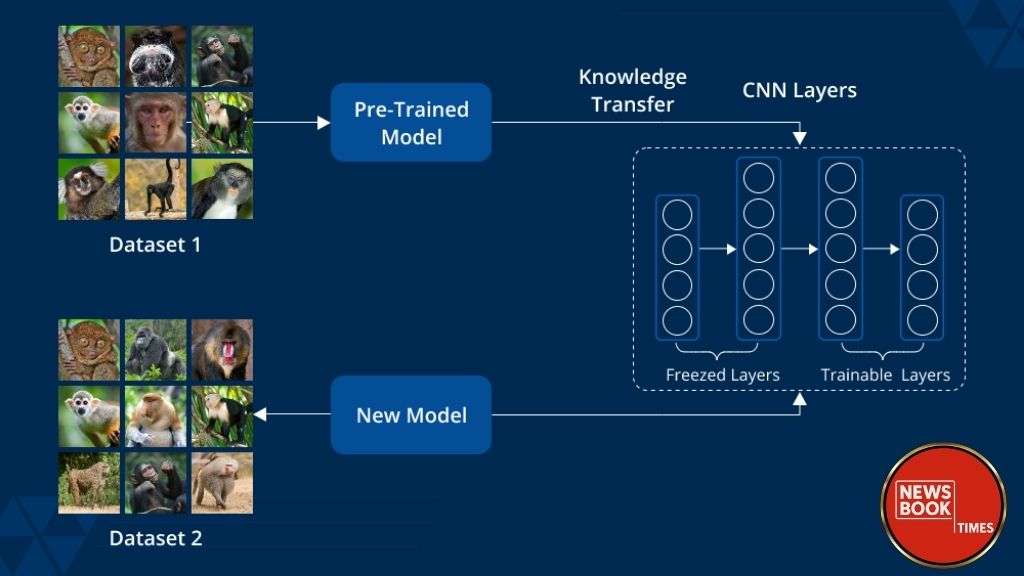
Transfer learning is the application of using old learning for a new task. When a machine learning model learns one task, it gains understanding of patterns and rules. These patterns may be useful for other such work. So the model is transferring its knowledge rather than starting from scratch again.
For example, If a computer system learns to recognize faces, it already understands shapes, edges, and shadows. This information can be later reused to identify the expressions or emotions. This concept of reusing learning is the primary principle idea for transfer learning in machine learning.
Why Transfer Learning Is Important
Training a machine learning model from scratch requires needs a large amount of data and powerful computers. Most organizations lack those resources. Transfer learning solves this problem.
Here are some reasons why it is important:
- It saves training time
- It needs less data
- It improves accuracy
- It lowers cost
- It reduces effort
Due to these advantages, transfer learning in machine learning is widely used in artificial intelligence, data science, and deep learning projects.
Read Also: Supervised Machine Learning
How Transfer Learning Works
The working process is simple to understand, here are the simple and easiest steps:
- A model is trained on a large dataset
- The model learns general patterns
- This trained model is reused
- Small changes are made for the new task
Most transfer learning methods use pretrained models. These models already know basic features and only need fine-tuning. This is what makes learning fast and smart.
A Real-Life Example
Imagine an experienced office manager who has been at one company for many years. When the manager moves to another company in the same industry, most skills, like planning, communication, and decision-making, are already known. Only company rules need to be learned.
This is how transfer learning in machine learning works. The machine retains all of its prior knowledge and only adapts it to the new task.
Common Uses of Transfer Learning
Transfer learning is used in many real-life fields:
- Healthcare: Models trained to detect one disease help identify others
- Finance: Credit risk models help in fraud detection
- Security systems: Image models help identify objects and faces
- Language processing: Text models help translate and understand languages
All these examples show how transfer learning in machine learning helps solve complex problems efficiently.
Transfer Learning and Deep Learning
Developers reuse existing deep learning models that are already trained on large datasets by utilizing transfer learning in machine learning. They refine these models for their own use. This approach saves resources and give better results.
Transfer learning can be very highly effective with deep learning. Deep learning models comprise umerous layers and learn complex patterns. They are expensive to train from scratch.
Benefits of Transfer Learning
Some major benefits include:
- Faster learning
- Better performance
- Reduced data need
- Lower computing cost
- Improved efficiency
Because of these benefits, transfer learning in machine learning is becoming a common method in modern AI development.
Limitations of Transfer Learning
Transfer learning is a powerful technique, but it has its limitations. The transferred knowledge is not applicable if the old and new tasks are too different. In these cases, the model can deliver poor results.
That is why experts carefully choose when to apply transfer learning in machine learning. Proper Understanding of data and tasks is crucial. If the source model was trained on biased or low-quality data, the same problem can be pass into the new model. Additionally, placing too much reliance on outdated information can stop the model’s ability to learn learn new patterns effectively. Careful testing and fine-tuning are much needed to make sure that transfer learning provides benefits instead of reducing performance.
Read Also: Reinforcement Learning in Machine Learning
Conclusion
At last, transfer learning in machine learning enables computers to access knowledge from the past and learn new tasks fast and effectively. It is time saving, low cost and also high in accuracy. This method is also fundamental to the modern field of artificial intelligence, helping technology grow smarter every day. In a world where data is increasing very fast, transfer learning anbles many machines to make the best decisions without requiring extensive new information.
It facilitates the faster development of intelligent systems in various fields, including finance, healthcare, security, and language processing. As technology continues to evolve with each passing day, this method will remain crucial for creating fast, smart, and practical machine learning solutions.